

Production Intelligence
Turn print production data into better decisions. Monitor workflow activity, identify trends, measure performance and improve efficiency.
The Smartest Person in the Room is the Person with the Most Information
The best decisions start with gathering information.
Every print production business makes hundreds of decisions every day: deciding which press to use for a job, substrates, tuning the machines, processing jobs, problem solving, where to utilize resources first, purchasing, how to improve, and more.
Production intelligence uses information generated by the print production workflow to help managers and production teams understand performance, identify trends, find bottlenecks, and make better operational decisions. The objective is to help you understand your operation well enough to make better decisions, with data directly from your workflow.
The smartest decisions come from having the accurate, meaningful data.

Understand the Impact of Ink Savings
When InkTune or SPIR@L is used, the APOGEE Production Dashboard displays ink-reduction data generated, which connects a production-saving initiative with measurable information that can be reviewed over time.
Business outcome: See the impact of cost-saving measures and make better-informed production decisions.

Connect Production and Quality Information
PressTune gathers data from presses across the network and presents it through a dashboard. Operators can see information relevant to press adjustments, prepress teams can use data to update tonal curves, and management can review overall trends.
Business outcome: Give different teams the information they need to improve production from their own part of the workflow.

See What Your Workflow Is Producing
APOGEE's Production Dashboard provides real-time production statistics, including the number of jobs, plates and proofs produced by day, week or month. It can also show job activity by operator.
Business outcome: A clearer picture of production performance and where your resources are being used.

Put Information in the Hands of the People Who Need It
Production intelligence shouldn't mean giving everyone the same spreadsheet.
Operators need to understand what is happening on the production floor.
Prepress teams need to identify workflow issues and opportunities for improvement.
Production managers need to understand workload, capacity and trends.
Management needs information that supports broader operational decisions.
Business outcome: A connected approach makes production information more useful because it can be applied where decisions are actually being made.

Identify Trends Before They Become Problems
Comparing daily, weekly and monthly activity gives managers a way to spot trends and ask better questions:
- Is production volume increasing?
- Are certain periods consistently busier?
- Is operator workload balanced?
- Are particular processes creating bottlenecks?
- Is production capacity keeping pace with demand?
Business outcome: Make decisions based on production trends rather than isolated events.

Know What is Happening in Your Production Workflow
Every print production business generates enormous amounts of production information. Jobs processed. Plates produced. Proofs created. Operator activity. Ink consumption. Press performance. Production trends.
The challenge is turning all that information into something useful, or having the time to.
Production intelligence gives managers a clearer view of what is happening across the workflow, helping them identify bottlenecks, understand performance and make better decisions about where to improve.
The business outcome: Move from reacting to production problems to understanding where and how to improve.
The Challenge: You Can't Improve What You Can't See
- Limited visibility into workflow activity
- Unclear workload trends
- Difficult to identify resource pressure
- Press performance variation
- Problems discovered after the fact
- Improvement initiatives that are difficult to measure
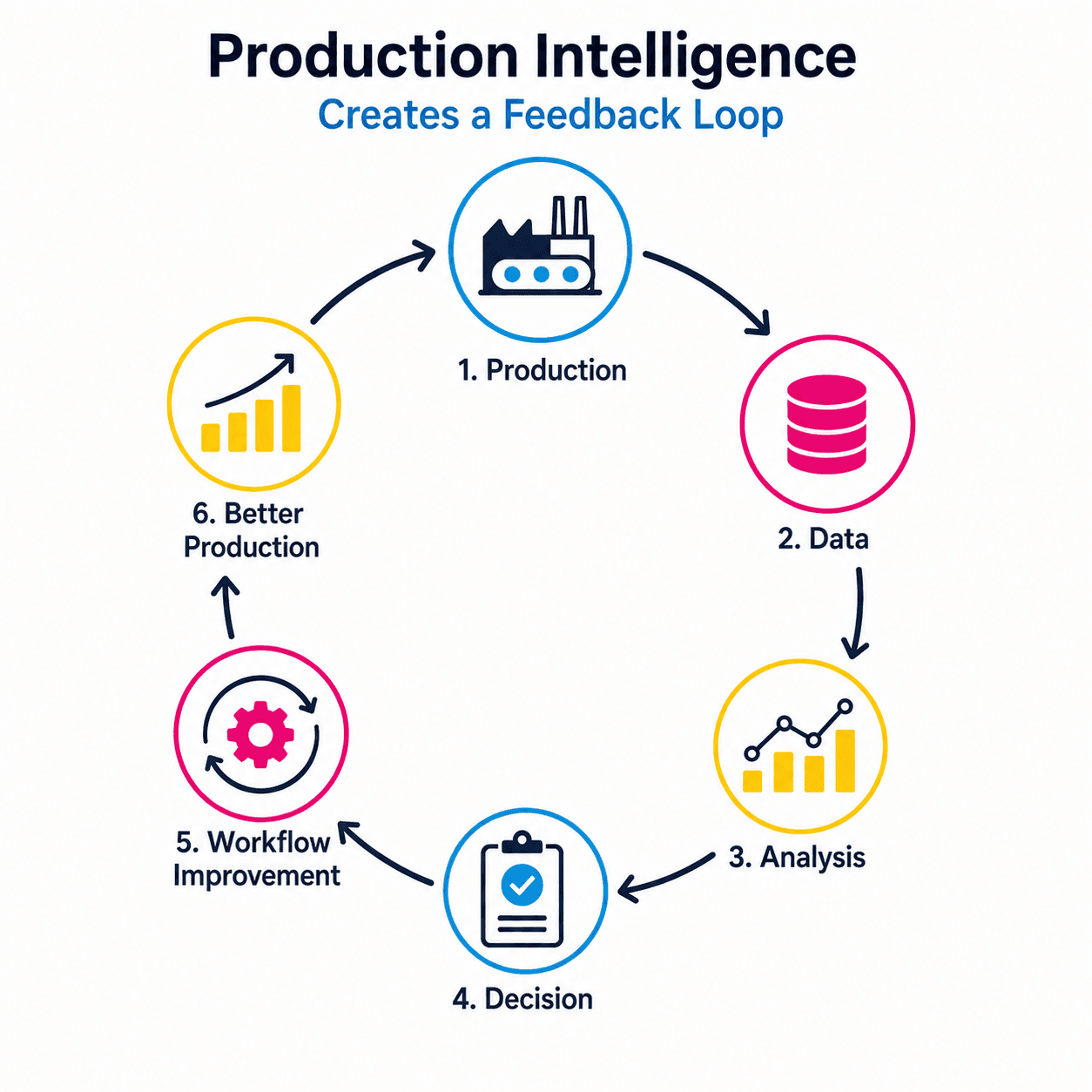
From Production Data to Continuous Improvement
The goal isn't simply to collect more data.
It's to turn production information into action.
Why ECO3?
ECO3's APOGEE Production Dashboard is built around information generated by the prepress production environment, giving printers access to statistics about actual production activity rather than requiring separate manual data collection.
The wider ECO3 workflow environment also connects automation, production, color management and integration, creating opportunities to use production information as part of continuous improvement.
The objective is to help you understand your operation well enough to make better decisions.

Frequently Asked Questions
- What is production intelligence in printing?
Production intelligence uses information generated by the print production workflow to help managers and production teams understand performance, identify trends, find bottlenecks and make better operational decisions.
- What production information can Apogee provide?
The APOGEE Production Dashboard provides statistics such as the number of jobs, plates and proofs produced by day, week or month, as well as job activity by operator.
- Can production intelligence help reduce costs?
Yes. Understanding production activity and trends can help identify opportunities for greater efficiency. When InkTune or SPIR@L is used, the APOGEE Production Dashboard can also provide information about ink reduction.
- Can I monitor production over time?
Yes. The Production Dashboard provides production statistics across daily, weekly and monthly periods, making it possible to identify changes and trends in workflow activity.
- Can production data help operators?
Yes. APOGEE's dashboard can provide information about job activity by operator, helping production managers understand workload and activity across the workflow.
- Can production intelligence include color and press information
Yes. PressTune gathers data from presses across a network and provides a dashboard for different stakeholders, including operators, prepress teams and management.
- Does production intelligence require a separate production system?
Not necessarily. APOGEE's Production Dashboard uses information generated by the APOGEE prepress workflow. Access to the dashboard requires the APOGEE system to be online and an APOGEEnetwork account.
Ready to Make Better Production Decisions?
You already have valuable information flowing through your print operation. The opportunity is to make that information useful. Production intelligence can help you understand workload, identify trends, measure improvements and make better decisions about how your operation runs.